How Much Does HACCP Implementation Cost in 2026: Full Comparison of 3 Options
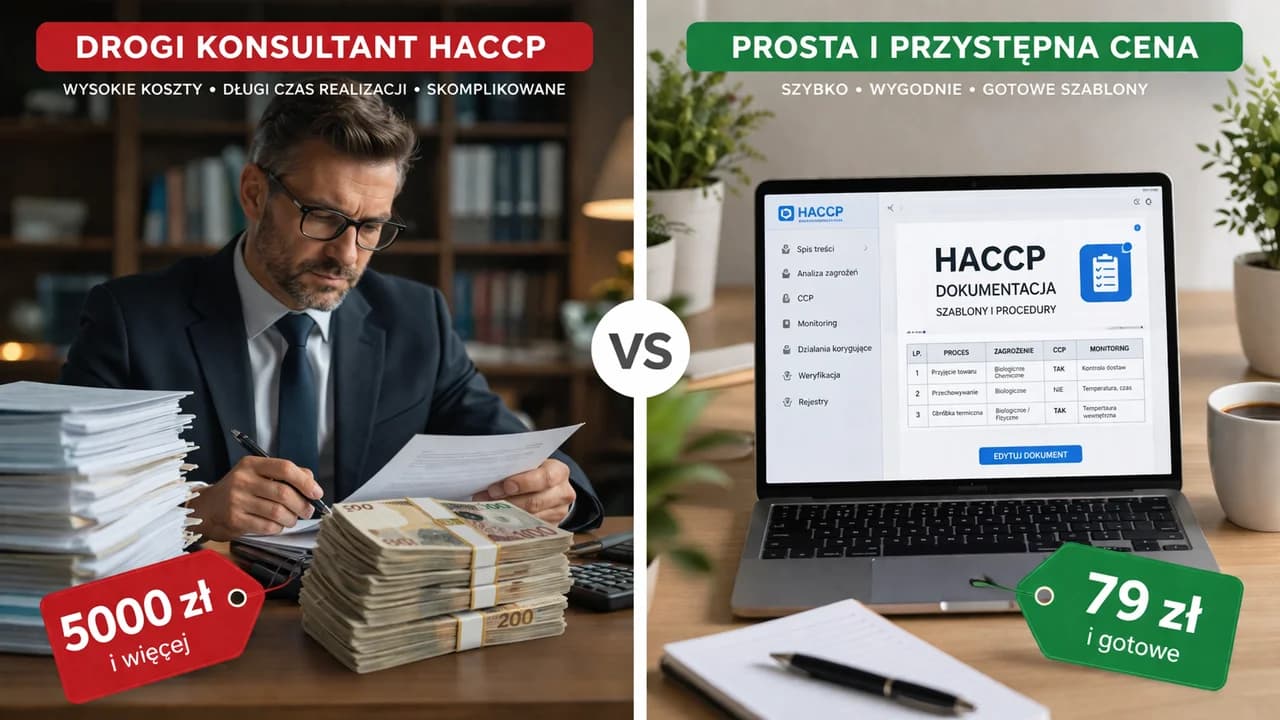
Food technologist (3000 to 10,000 PLN) vs ready templates (200 to 500 PLN) vs from scratch (0 PLN plus 30 to 60 hours). Pros, cons, when each makes sense.
Implementing HACCP in foodservice costs from 0 to 10,000 PLN - depending on which path you take. A food technologist is an expense of 3000 to 10,000 PLN. Ready documentation templates cost 200 to 500 PLN. Doing it yourself from scratch is 0 PLN, but tens of hours of your time and the risk that the documentation will not pass inspection. In this article I compare all three options honestly - with prices, pros, cons and a specific recommendation matching option to venue type.
Key takeaways:
- A food technologist is the priciest option (3000 to 10,000 PLN), but reasonable for large sites and unusual processes.
- Ready documentation templates (200 to 500 PLN) offer the best price-to-value ratio for most foodservice venues.
- Building documentation from scratch is free, but requires knowledge and time - realistically 30 to 60 hours of work.
- The cost of missing HACCP documentation (fines, venue closure) far exceeds the cost of any of the above options.
- For typical small and medium foodservice, a ready package for 299 to 399 PLN closes the topic faster than a week of solo work.
Three ways to implement HACCP
Every foodservice venue in Poland must have an HACCP system - required by the Food Safety Act and Regulation (EC) No 852/2004. There is no exception. The question is not "whether to implement" but "how and at what cost".
In 2026 you have three realistic paths:
- Food technologist - hire a specialist who prepares documentation tailored to your venue.
- Ready documentation templates - buy a tested package and adapt it to your venue.
- From scratch yourself - learn, write, compile everything alone.
Each option has its place. None is "bad", but each fits a different venue type, budget and situation. Let us walk through them in order.
Option 1: Food technologist (3000 to 10,000 PLN)
A food technologist is a specialist who visits your venue, analyses processes, writes documentation from the ground up and often helps prepare for sanitary inspection. This is a "bespoke service".
What you get:
- Venue visit and process audit
- Complete HACCP documentation written for your specific site
- GHP/GMP procedures matched to your equipment and menu
- Hazard analysis and CCP setting
- Records and forms ready for daily use
- Often: team training and inspection support
What it costs in 2026:
- Small venue (bar, cafe, food truck): 3000 to 5000 PLN
- Medium venue (restaurant, catering): 5000 to 8000 PLN
- Large site (hotel, canteen, chain): 8000 to 10,000 PLN plus
- Additional costs: documentation updates (500 to 1500 PLN annually), repeat visits
Pros:
- Documentation is fully personalised: it describes exactly your venue
- The specialist takes substantive responsibility
- You save your own time: you do not have to learn from scratch
- For complex processes (production, diet catering) it is the only sure option
Cons:
- High price: for a small venue, often a month of rent
- Hard to verify quality before paying
- The market is unregulated: not every "technologist" has actual competence
- Updates cost extra (menu change equals another visit)
- Documentation is yours, but the knowledge stays with the technologist: the team does not understand what is in the papers
When it makes sense: Large sites with multiple processes. Venues with unusual production (diet catering, processing). Situations when sanitary inspection already visited and issued recommendations - you need someone who can "put out the fire" fast.
Option 2: Ready documentation templates (200 to 500 PLN)
Ready templates are complete HACCP document packages that you buy and adapt to your venue. You do not start from a blank sheet: you get a tested structure, procedures, records and instructions. You fill in your venue data, adjust details to your menu and equipment.
What you get (depending on supplier):
- Ready HACCP document set (procedures, records, instructions)
- GHP/GMP procedures ready to personalise
- Record forms for daily use
- Hazard analysis and sample CCPs
- Implementation instructions (how to adapt to your venue)
Supplier comparison on the market:
The market has several suppliers of ready HACCP documentation. Prices range from 150 PLN for a basic PDF template to 500 PLN for a complete package with instructions and support. Differences cover three main things: completeness (how many documents), quality (whether records are practical) and support (whether anyone answers questions).
The cheapest options (100 to 200 PLN) are usually a PDF with generic procedures: no records, no personalisation instructions, often no current legal basis. You buy something that looks like a template. Packages in the 250 to 500 PLN range are a different league.
At GastroReady, for example, the Foundation package (299 PLN) contains complete HACCP documentation with GHP/GMP procedures, records, PL/EN workstation instructions and hazard analysis - all in editable formats, ready to personalise. The Shield package (399 PLN) adds expanded support: full PL/EN instruction set for multilingual teams, extra operational records and team training materials. This is not a "template to print" - this is a system designed to work in your kitchen.
Pros:
- Price-to-value ratio: 10 times cheaper than a technologist, comparable documentation quality
- Fast deployment: you have a base in one day, full rollout in several days
- Editable formats: you can update yourself on menu changes
- Tested structure: documents written by specialists, aligned with legal requirements
- You do not pay for updates: you change yourself when needed
Cons:
- Requires your engagement: you must fill in venue data, adapt to your reality
- Will not replace a specialist for very unusual processes (e.g. meat curing, hospital catering)
- Quality depends on the supplier: cheap templates can be as worthless as free ones
When it makes sense: For most small and medium foodservice venues. Restaurants, bars, cafes, food trucks, catering - if your processes are standard (goods receipt, storage, processing, service), a ready package covers 95 percent of your needs. You just personalise it.
Option 3: From scratch yourself (0 PLN plus time)
Theoretically you can write the whole HACCP documentation yourself. Information is available - the act, regulations, guides on sanitary inspection sites. The question is how long it will take and what the result will look like.
What you must do:
- Study legal requirements (Food Safety Act, Regulation 852/2004)
- Understand the 7 HACCP principles and 12 implementation steps
- Describe your venue and processes
- Run hazard analysis
- Set Critical Control Points (CCPs)
- Write GHP/GMP procedures
- Create records and forms
- Prepare staff instructions
- Deploy the system and train the team
Realistic time:
If you have no experience with HACCP documentation, prepare for 30 to 60 hours of work. This is not an exaggeration. Just understanding requirements takes several hours of reading. Writing procedures, hazard analysis, preparing records - each is another batch of hours. Plus verification, corrections and team rollout.
If you run a venue and write documentation after hours - realistically it takes 3 to 6 weeks. And during that time you have no working HACCP system, which means risk in case of inspection.
Pros:
- Zero financial cost
- You learn the system from basics: you understand every element
- Documentation is 100 percent yours and matched to your venue
Cons:
- Huge time investment: 30 to 60 hours that could go to running the business
- High error risk: without experience, easy to skip important elements
- No certainty that documentation will pass sanitary inspection
- No record templates: you must invent the format from scratch
- Time without documentation equals risk time (inspection may come any moment)
When it makes sense: Only in two situations. First: you have education or experience in food technology and know what you are doing. Second: you have plenty of time and want to learn the system from basics (e.g. opening planned for several months ahead). For an active venue needing documentation "yesterday", this option is not realistic.
Cost comparison: table
The table below compares all three HACCP implementation options in one place. I compare not just price, but time, risk and what you actually get.
| Criterion | Food technologist | Ready templates | From scratch |
|---|---|---|---|
| Cost | 3000 to 10,000 PLN | 200 to 500 PLN | 0 PLN |
| Deployment time | 2 to 4 weeks | 1 to 5 days | 3 to 6 weeks |
| Your engagement | Minimal | Medium (personalisation) | Maximum |
| Personalisation | Full (bespoke) | High (editable formats) | Full (depends on your knowledge) |
| Error risk | Low | Low to medium | High |
| Updates | Paid (500 to 1500 PLN per year) | Self (free) | Self (free) |
| Team training | Often included | Instructions in package | You must develop |
| Inspection confidence | High | High (with a good supplier) | Low to medium |
| Best for | Large sites, unusual processes | Small and medium venues | People with sector experience |
One thing the table does not show directly: the cost of missing documentation. A sanitary fine is up to 500 PLN on the spot, an administrative penalty can be tens of thousands of PLN, and venue closure means lost revenue for every downtime day. At those amounts, even the priciest HACCP implementation option is cheap.
Which option is best for you
There is no single answer. The choice depends on venue size, budget, time and your experience. Here is a simple decision scheme:
Small venue (bar, cafe, food truck, bistro):
Ready documentation templates. Your processes are standard, documentation does not need to be complex. A package for 299 to 399 PLN gives you everything you need. A technologist at 4000 PLN is overpaying for something you can deploy in several days.
Medium venue (restaurant, catering, pizzeria):
Ready documentation templates with solid personalisation. With a richer menu and several processes (thermal processing, cooling, delivery) you need more records and procedures, but still no need to pay for a technologist. A Shield-tier package even covers venues with multilingual teams via PL/EN instructions.
Large site (hotel, workplace canteen, chain):
Food technologist. With many service points, expanded HACCP and specific processes, you need someone to analyse everything on site. A cost of 5000 to 10,000 PLN is justified by scale.
Unusual production (diet catering, processing, manufacturing):
Food technologist. If you have processes that no ready template will describe (e.g. modified-atmosphere packing, preserves production), you need an individual approach.
You are planning to open (3-plus months ahead):
You can start with self-learning to understand the system. But at the finish, it pays to have a ready package as a base: it saves dozens of hours and gives confidence you have not missed anything.
FAQ
How much does HACCP implementation cost?
The cost of HACCP implementation in foodservice in 2026 ranges from 0 to 10,000 PLN, depending on the chosen method. A food technologist costs 3000 to 10,000 PLN. Ready documentation templates cost 200 to 500 PLN. Self-prep is free but requires 30 to 60 hours of work. For most small and medium venues, the best choice is ready documentation packages at 299 to 399 PLN, combining professional quality with reasonable price.
Can HACCP be implemented yourself?
Yes, the law does not require HACCP documentation to be built by a food technologist. You can do it yourself. The question is whether you have time and knowledge. Realistically it is 30 to 60 hours of work, and the risk of missing important elements is high. Without industry experience, definitely start with ready templates - you will save time and reduce error risk.
How much does a food technologist cost?
A food technologist preparing complete HACCP documentation charges 3000 to 10,000 PLN, depending on size and complexity. Small venue: 3000 to 5000 PLN. Medium restaurant: 5000 to 8000 PLN. Large site (hotel, canteen): 8000 to 10,000 PLN or more. Additionally, documentation updates cost 500 to 1500 PLN annually. Worth knowing: the food technologist market is unregulated. Before choosing, check references and experience.
The choice of HACCP implementation method comes down to a simple sum: for 299 to 399 PLN you get complete documentation ready to personalise. 10 times cheaper than a technologist, 10 times better than from scratch. For a typical foodservice venue, this is the most sensible investment: professional quality, fast deployment and zero risk of forgetting something important. GastroReady HACCP documentation rolls out in several days, and peace of mind during sanitary inspection stays for years.
Need complete HACCP documentation?
GastroReady offers ready HACCP, GMP and GHP templates for every type of foodservice venue. From 299 PLN, with PL/EN instructions.