Multilingual Kitchen Team: How to Implement PL/EN Instructions That Actually Work
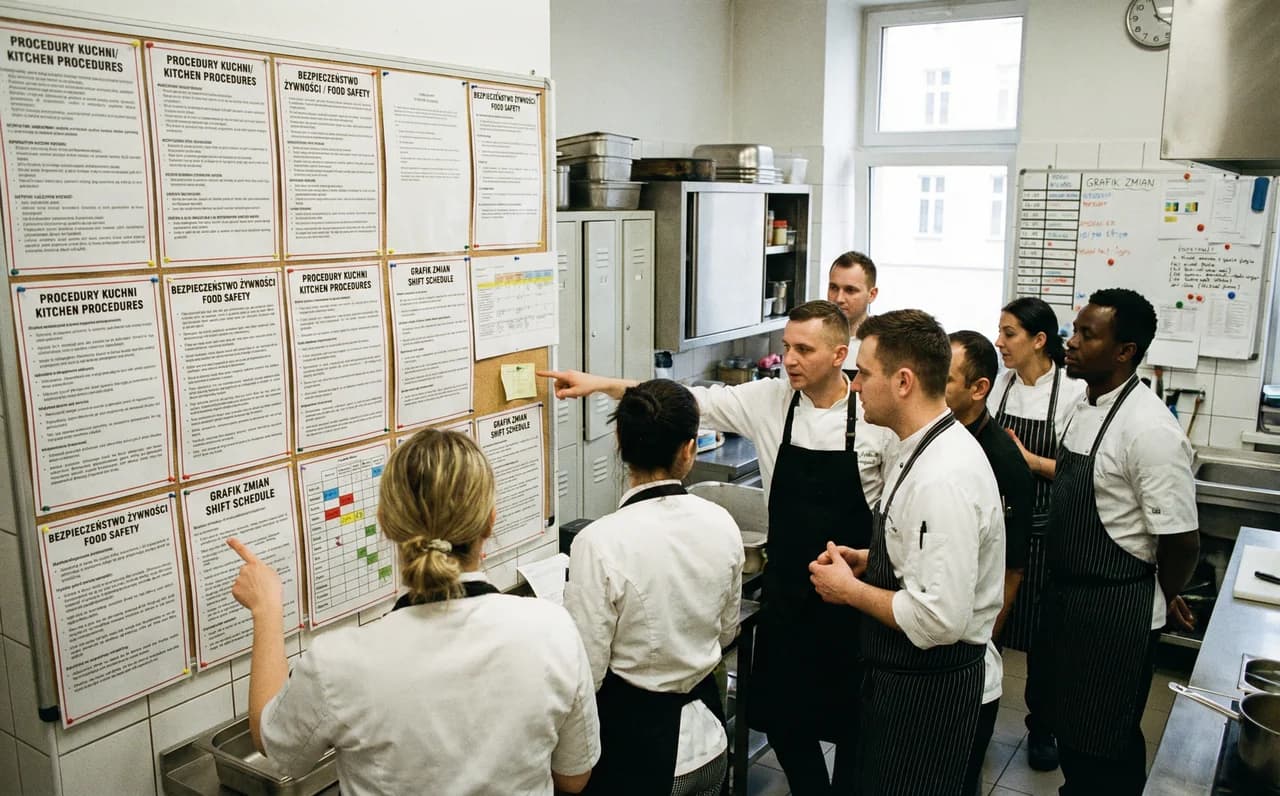
Why bilingual instructions make life easier and how to introduce them so everyone actually uses them.
In food service, the problem is rarely "we don't have procedures." The problem is: procedures exist, but people do things differently - because they don't understand, don't remember, don't have time to read, or "everyone has their own style." In a PL/EN team, this multiplies: one person understands the document, the rest only understand fragments. And then HACCP/GHP/GMP exist only in a binder. This post gives you an implementation plan. Full PL/EN instructions, "kitchen-ready" materials, and a consistent system are in GastroReady.
Why PL/EN is not a "nice extra" but a shield
A multilingual team increases the risk of:
- allergen errors (a worker does not understand what the dish contains)
- mistakes at the pass and in packing (swapped packages because labels were unreadable)
- errors in records (nonsense entries because someone did not understand what to write)
- inconsistent answers during inspector questions (everyone says something different because everyone understood it differently)
If a standard cannot be communicated in 30 seconds - it is not a standard. It is a document sitting in a drawer.
Common translation mistakes: why Google Translate does not know HACCP
You paste a procedure into Google Translate and think you have an English version? You don't. You have chaos. Here are real examples:
"Dezynfekcja powierzchni roboczych" - Google Translate: "Disinfection of working surfaces." Sounds OK? The problem: in a HACCP context, the correct term is "sanitizing food contact surfaces," because "disinfection" sounds medical and "working surfaces" does not specify food contact.
"Przyjecie towaru" - Google Translate: "Acceptance of goods." In HACCP, this is "goods receiving" or "incoming goods inspection." "Acceptance" implies you already accepted it - but you check first.
"Odchylenie od normy" - Google Translate: "Deviation from the norm." In HACCP, the correct term is "corrective action trigger" or simply "deviation" (in a CCP context). "Norm" is too generic.
"Obrobka cieplna" - Google Translate: "Heat treatment." In food service, this is "cooking" or "thermal processing." "Heat treatment" sounds like metalwork.
That is why translating HACCP instructions is not a job for an automated translator. It is a job for someone who knows industry terminology in both languages. Or for GastroReady, where PL/EN instructions are written from the start in both versions with correct terminology.
Pictograms and color codes: a language everyone understands
Not every language problem can be solved by translation. Sometimes a visual is a better solution. Here is what works in practice:
Pictograms. A simple drawing of "handwashing" on the wall by the sink works better than a page of text. A "raw meat" pictogram on the cold room door says more than a sign reading "Cold Room No. 2 - Raw Products of Animal Origin." Use pictograms at: sinks, cold room doors, production zones, waste containers, chemical storage cabinets.
Color codes. Red cutting board = raw meat. Green = vegetables. Blue = fish. Yellow = poultry. This is not a "nice extra." It is a system that eliminates language errors because colors need no translation. Boards, knives, containers - all in the same color code.
Day-of-the-week color labels. Monday = blue, Tuesday = yellow, etc. A sticker on a container says: "opened on Monday" - without words. Every worker, regardless of language, sees the color and knows when the product was opened.
The "show me" technique: verification without an exam
Training on instructions is one thing. Verification is another. But a written test in a multilingual team is asking for trouble - because you are testing language, not knowledge. Instead: the "show me" technique.
You say to the worker: "Show me where you log temperatures." You do not ask "where do you log them" - you ask them to walk over and show you. Physically. If they go to the right log and point to the right column - they know. If they get confused - they don't, regardless of what they say.
Other variants: "Show me how you wash your hands" (you observe technique). "Show me what you do with a delivery that looks wrong" (you observe the decision). "Show me where the first aid kit is" (you observe if they know).
This technique eliminates the language barrier, gives real information about the worker's skills, and is fast - 2 minutes per person. Log the results: date, person, what they demonstrated, whether OK. This is your proof of implementation.
Specifics for Ukrainian and English-speaking teams
In Polish food service, you most commonly encounter two foreign-language groups: Ukrainian workers and English-speaking workers (India, Nepal, other countries).
Ukrainian workers: the languages are similar, but that is a trap. Words sound familiar but mean different things. The best approach: instructions in simple Polish + pictograms + the "show me" technique. Ukrainian workers learn Polish quickly, but in the first weeks - do not assume they understand procedures just because they nod.
English-speaking workers: the barrier is greater for them because Polish and English share no common roots. PL/EN instructions are a necessity, not an option. But note: even with an English instruction, HACCP terminology may be unfamiliar. A worker from Nepal may have never heard of "cross-contamination" or "critical control point." You need not just a translation but also an explanation - what these concepts mean in kitchen practice.
The cost of miscommunication: real scenarios
Scenario 1: A worker does not understand the cleaning/sanitizing instructions. They wash the surface with water but do not use sanitizer because they did not understand the two-step procedure. Result: bacteria on the surface, potential food contamination. Cost: complaints, food poisoning, venue closure.
Scenario 2: A worker receives a delivery and does not check the temperature because they did not understand it was mandatory. Frozen goods sit on the loading dock for 40 minutes. Result: broken cold chain, wasted product. Cost: several hundred in product + risk to the customer.
Scenario 3: A worker packs a catering order and swaps packages because they did not understand the allergen labels. A customer with a nut allergy receives a dish with nuts. Result: allergic reaction. Cost: impossible to measure.
Each of these scenarios could have been prevented by one thing: an instruction the worker actually understands.
Wall-mounted instructions: how to design them so they actually work
A3 format, not A4. A4 is too small to read from a meter away. A3 is readable from 2-3 meters - even on the move.
Maximum 7 points. Nobody reads more than that. If you have 15 rules - split them into 2 instructions on 2 walls.
Pictograms next to text. Text on the left (PL/EN), pictogram on the right. An image catches the eye faster than a word.
Laminated or covered in film. Paper in a kitchen lasts 3 days. A laminated instruction lasts months. Cost: around 1 EUR for lamination. Cost of reprinting every week: frustration and no standard.
Placement. Handwashing instruction - above the sink. Goods receiving instruction - by the loading dock/storage door. Packing instruction - on the packing table. Not in the office. Not in the hallway. Where the worker needs it.
3 levels of instructions that actually work
Level 1: "Critical rules" (5-10 points). These are rules that must be memorized:
- raw vs ready-to-eat,
- allergens,
- cleaning/sanitizing after specific events,
- the pass/packing,
- what to do when there is a deviation.
This must be short, simple, and accessible to everyone - on the wall, in PL and EN.
Level 2: "Workstation instructions." Not an encyclopedia. One page:
- what I do at this workstation,
- how I do it,
- what I use and where I log it.
Level 3: "System procedures." These can live in the documentation - but only if Level 1 and Level 2 are alive in the kitchen.
How to implement PL/EN instructions in 7 days
Day 1-2: critical rules only + kitchen tour (zones, tools, logs). Day 3-4: workstation instructions + short "show me where and how" test. Day 5-7: work during the rush + checks at the pass/packing + corrections. You are not training "for the sake of training." You are implementing under stress - because in a real kitchen, stress cannot be eliminated, only managed.
Mini-test: does PL/EN work in your operation?
YES/NO:
- Can a new team member find the logs and know what to enter?
- Can your team handle an allergen order without chaos?
- Does everyone know what to do when something goes wrong (e.g., contamination, deviation, delay)?
- Are the rules visible in the kitchen, not just in a PDF?
- Do the wall-mounted instructions have an English version?
- Do you use the "show me" technique instead of yes/no questions?
If you answered NO 2-3 times - you need an implementation system, not "yet another document."
Where GastroReady comes in
GastroReady delivers PL/EN instructions as a ready-made system: critical rules for the wall, workstation instructions, system procedures - all with correct HACCP terminology in both languages (not from Google Translate). Plus: pictograms, color codes, and onboarding materials that let you train a new worker in 7 days, regardless of what language they think in. Because a standard that is not understood is not a standard.
Need complete HACCP documentation?
GastroReady offers ready-made HACCP, GMP, and GHP templates for every type of food business. From 299 PLN, with PL/EN instructions.