How to Open a Restaurant in Poland 2026: Step-by-Step Guide
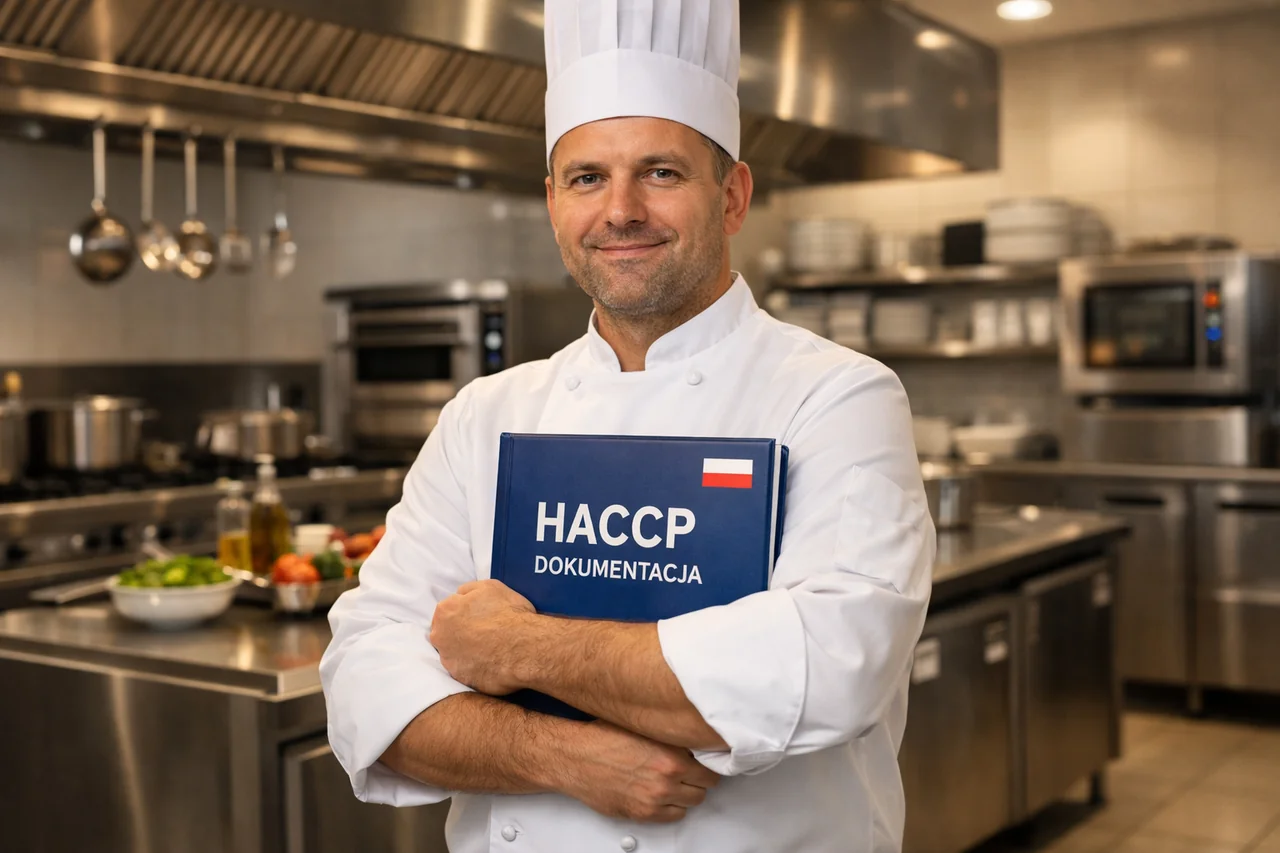
From business registration to opening day. 7 steps, realistic 8 to 16 week timeline, costs and the most common opening mistakes.
Opening a restaurant in Poland requires going through a dozen formalities - from business registration, through premises adaptation and sanitary inspection approval, to HACCP documentation rollout. The whole process realistically takes 8 to 16 weeks, depending on the state of the premises and your preparation. This guide walks you through every step chronologically, without unnecessary jargon, with specific deadlines and costs current for 2026.
Key takeaways:
- Business registration in CEIDG is free and takes 1 business day - this is the first step that unlocks other formalities.
- The sanitary inspection notification must be filed at least 14 days before opening, but it pays to have a pre-renovation consultation first.
- HACCP/GHP/GMP documentation does not need to be an encyclopaedia - it must be consistent with your venue, menu and processes.
- The biggest delays come not from formalities, but from lack of planning: a bad kitchen layout, mismatched ventilation, or documents inconsistent with reality.
- Planning all steps in advance lets you open the venue without stress and without costly corrections.
Step 1: Business registration
Before you start anything else, you need a formal legal basis. In Poland you can run a restaurant as a sole proprietorship (JDG), civil partnership or limited liability company. Most beginning restaurateurs pick JDG - it is fastest and cheapest to start.
What you need to do:
- Register your business in CEIDG - the application is filed online or at the municipality office. Registration is free. Pick the right PKD code: 56.10.A (restaurants and other stationary foodservice) as primary, optionally 56.21.Z (catering) or 56.10.B (mobile foodservice).
- Register with ZUS - you have 7 days from starting business activity. As a new entrepreneur you may use the startup relief (6 months without social contributions) and preferential ZUS (24 months of lower contributions).
- Decide on tax form - the most common are flat-rate tax (19 percent) or progressive scale (12 percent/32 percent). Lump-sum in foodservice is 8.5 percent on revenue. Talk to an accountant before you decide.
- Register as a VAT payer - if you plan turnover above 200,000 PLN annually (very likely in foodservice), do it from the start.
At this stage you do not need premises yet. But if you have them, you can start subsequent steps in parallel.
Step 2: Choosing and adapting premises
The premises choice determines most of your future costs and constraints. Before you sign a lease, check several things that can save you tens of thousands of PLN:
- Use under the zoning plan - can the premises serve foodservice purposes? Not every commercial unit allows this.
- Ventilation - the kitchen needs separate extract and supply ventilation. Adding it in a residential building can be very expensive or even impossible.
- Water and drainage - you need hot and cold water at workstations, a separate handwash sink, a grease trap (in many cases).
- Zone separation - the kitchen must allow logical flow: delivery, storage, preparation, cooking, service. Even in a small venue this flow must be thought through.
Practical tip: book a pre-renovation consultation at the sanitary inspectorate before any work starts. The inspector will tell you what is doable in this venue and what could be a problem. It is an informal conversation, but it can save the budget.
During renovation, take care of washable surfaces (walls, floors), proper lighting, chemical storage away from food and a separate staff locker room. These elements come up at every inspection.
Step 3: Sanitary formalities and inspection notification
This is the stage that triggers the most anxiety, while being more predictable than it seems. The sanitary inspector is not there to block you - they are there to make sure your venue meets basic food safety requirements.
You must file an application for venue approval and entry into the register at the District Sanitary-Epidemiological Station for your venue's location. Minimum 14 days before planned opening - but realistically plan a 3 to 4 week buffer.
What to attach:
- Completed application form (available at the PSSE or on their site)
- Technological plan of the venue with equipment description
- Current CEIDG or KRS excerpt
- Lease agreement or proof of ownership
After filing, the inspector schedules a venue visit. Checks technical condition, zone layout, installations, equipment and - importantly - your HACCP documentation. If everything is in order, you receive an approval decision. If there are irregularities, you receive a deadline for fixes.
Step 4: HACCP, GHP and GMP documentation
Every foodservice venue in Poland must have an HACCP system based on Codex Alimentarius principles. This is not optional - it is a legal obligation. But the good news: for small and medium foodservice, the system does not have to be complicated. It must be consistent with what actually happens in your kitchen.
What your documentation should cover:
- GHP procedures (Good Hygiene Practice) - personnel hygiene, cleaning and disinfection, waste management, water supply, pest control
- GMP procedures (Good Manufacturing Practice) - goods receipt, storage, processing, service, transport
- HACCP system - hazard analysis, Critical Control Points (CCP), critical limits, monitoring, corrective actions
- Records - temperatures, cleaning, goods receipt, staff training
Common mistake: pulling a ready template off the internet and dropping it in a folder. The inspector immediately sees the document describes a different venue. This is one of the most common reasons for findings during inspection.
GastroReady documentation packages are prepared to match your specific profile - restaurant, bar, cafe or catering. You do not get a generic template, just a set tailored to your reality, with implementation instructions and ready records. Over 500 venues in Poland use these documents daily.
Step 5: Licences, permits and other formalities
Besides the sanitary inspectorate and HACCP, there are several more formalities worth remembering:
Alcohol sales
If you plan to serve alcohol, you need a permit from the municipality office. There are three categories: up to 4.5 percent (beer), up to 18 percent (wine) and above 18 percent (spirits). The fee depends on the category and annual turnover: starting at 525 PLN, 525 PLN and 2100 PLN annually. The application is filed at the municipality office for the venue location.
Cash register
In foodservice, a fiscal cash register is mandatory from the first day of sale to individuals. There is no turnover-based exemption. More and more restaurateurs pick online cash registers, which automatically transmit data to the Central Cash Register Repository.
Music in the venue
If you play music, you need a ZAiKS licence and possibly STOART/ZPAV. Costs depend on the venue area and whether the music is recorded or live.
GDPR and policies
If you collect customer data (online reservations, newsletter, CCTV), you need a privacy policy and must meet GDPR requirements. This also covers video monitoring - if you use it, you must inform about it.
Step 6: Realistic timeline and budget
Here is an approximate timeline for someone opening a restaurant from scratch. Every venue is different, but this sequence works in practice:
- Week 1 to 2: CEIDG registration, premises selection, lease signing, pre-renovation consultation at the sanitary inspectorate
- Week 2 to 8: Renovation and venue adaptation (installations, surfaces, kitchen equipment)
- Week 6 to 8: HACCP/GHP/GMP documentation preparation, team hygiene training
- Week 8 to 10: Filing application with the sanitary inspectorate, inspector visit, any corrections
- Week 9 to 10: Alcohol permit application (if applicable), cash register purchase
- Week 10 to 12: Operational testing (soft opening), team further training, process corrections
- Week 12+: Official opening
Approximate formal costs (without renovation and equipment):
- CEIDG registration: 0 PLN
- Entry into the sanitary register: 0 PLN (administrative decision)
- HACCP/GHP/GMP documentation: from 299 PLN (Foundation package at GastroReady) to several thousand for bespoke work
- Alcohol permit: 525 to 2100 PLN annually (per category)
- Online cash register: 1500 to 3500 PLN
- OHS training for employees: 100 to 200 PLN per person
Formalities alone do not have to be expensive. The biggest costs are renovation, equipment and the first months of operation, when revenue is still ramping up.
Step 7: Pre-opening final checklist
Before you officially open the doors to guests, walk through this checklist. Each point is something an inspector may check at the first inspection, but above all - these are the foundations of a safe and smooth operation:
- Sanitary inspectorate approval decision - you hold it and it is final
- HACCP/GHP/GMP documentation - printed, available, the team knows where it sits and what is in it
- Records - started and kept from day one (temperature, cleaning, goods receipt)
- Team training - every employee has gone through hygiene and food safety training, it is documented
- Health books - sanitary-epidemiological exams for all employees in food contact
- Extinguishers and OHS markings - current inspections, evacuation route marked
- Waste collection contract - including foodservice waste
- Cash register - registered with the tax office, fiscalisation complete
- Liability insurance - not mandatory, but strongly recommended
If all of the above is checked off, you are ready. Not on paper - for real. And that is exactly the difference between a venue that passes every inspection without stress and one that lives in constant tension.
Common mistakes when opening a restaurant
They recur in almost every conversation with beginning restaurateurs. Here are five most common ones that cost time, money and nerves.
Renovation without sanitary consultation
The owner renovates the venue, invests tens of thousands of PLN, and then at the visit it turns out the ventilation is insufficient, the handwash sink is missing, or the zone layout does not allow proper flow. Post-renovation fixes are double the cost. A pre-renovation sanitary consultation is free and takes an hour, but can save tens of thousands.
No plan for HACCP documentation
The restaurateur focuses on the interior, menu and hiring, and remembers about HACCP the day before the inspector's visit. Documentation prepared "yesterday" is full of gaps and inconsistencies. Start preparing HACCP/GHP/GMP documentation in parallel with renovation, not after.
Underestimating operational costs
The opening budget is one thing, the survival budget for the first three months is another. Rent, salaries, ingredients, utilities, ZUS, insurance - these costs run even when the dining room is empty. Good practice is to have a financial buffer for at least 3 months of operating costs before opening.
Skipping team training
New team, new venue, time pressure. OHS and hygiene training falls to the bottom. But the inspector at the first inspection will ask for training records. An untrained employee that the inspector finds in the kitchen is a fine and a non-compliance in the protocol.
Ignoring outdoor seating and external signage
Want to place tables on the pavement? You need road manager consent. Want to hang a sign? Check the zoning plan and the community bylaws. These small formalities can generate municipal warden fines and conflicts with neighbours, distracting you from what matters: cooking and serving guests.
Frequently asked questions
How much does it cost to open a restaurant in Poland in 2026?
Formalities alone (registration, sanitary, documentation, permits) cost 2000 to 5000 PLN. The total opening budget - with renovation, kitchen equipment, furniture and reserve for the first months - ranges from 150,000 to 500,000 PLN for a typical 80 to 150 square metre venue. The difference depends mainly on the premises state, location and finish standard.
What documents are needed to open a foodservice venue?
Minimum: CEIDG (or KRS) entry, sanitary approval decision, HACCP/GHP/GMP documentation, employee sanitary-epidemiological exams, OHS training, cash register registration. If serving alcohol - municipality permit. If outdoor seating - road manager or community consent.
How long does it take from idea to first guest?
With smooth execution and a venue needing standard renovation - 10 to 16 weeks. If the venue requires serious infrastructure work (ventilation, plumbing), the time can extend to 20 to 24 weeks. Planning quality has the biggest impact on tempo - restaurateurs preparing documentation and formalities in parallel with renovation save 4 to 6 weeks.
Can I open a restaurant without foodservice experience?
Formally yes - the law does not require sector education or experience. But you must have an HACCP system and trained staff. In practice, lack of experience means higher risk of operational mistakes, which is why it pays to invest in solid documentation and procedures that guide you step by step. Many owners using GastroReady packages start without prior foodservice experience.
What happens if you open a restaurant without sanitary notification?
Running foodservice activity without sanitary approval is a violation that can result in a fine up to 5000 PLN or a court-imposed penalty. The inspector may also order immediate suspension of activity until a decision is obtained. This is not a scenario to fear - filing the application with appropriate lead time and going through the normal procedure is enough.
Need HACCP documentation for a restaurant?
GastroReady offers ready HACCP, GMP and GHP templates tailored to foodservice. Fill in one evening, pass the sanitary inspection.