Food Truck HACCP Template: How to Fill It In
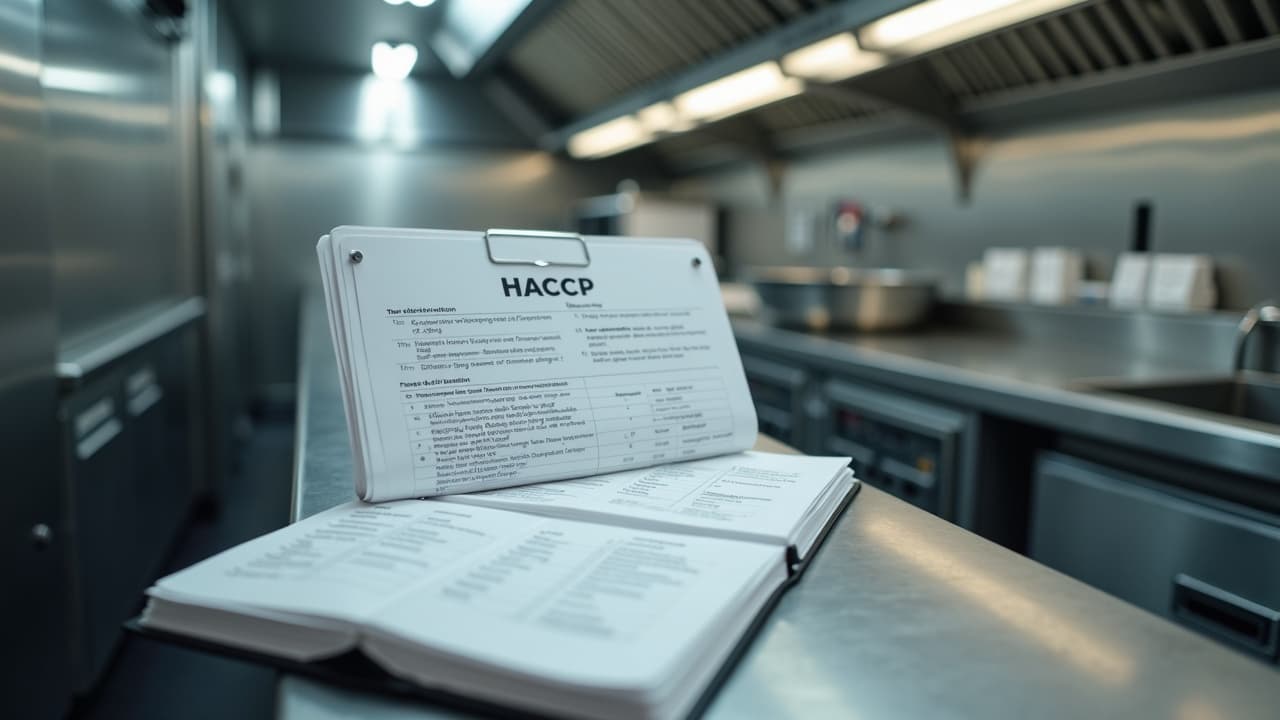
A restaurant HACCP template does not work for a food truck. If you take a blank restaurant plan and fill in your truck's name at the top, you will produce a…
A restaurant HACCP template does not work for a food truck. If you take a blank restaurant plan and fill in your truck's name at the top, you will produce a document that misses the most significant hazards in mobile food operations. Sanepid inspectors know this, and they will find the gaps. This guide explains what makes a food truck HACCP plan different, what sections it must contain, and how to fill in each one correctly.
What Is Different About a Food Truck vs. a Restaurant
Before filling in any template - whether your own draft or a ready-made HACCP documentation package for food trucks - you need to understand the hazards that are unique to your operation. A restaurant has mains water, a fixed drain, a stable power supply, and a permanent address. Your food truck has none of those things. Each difference creates a specific food safety risk that must appear in your HACCP plan.
Water Source
You are not connected to mains water. You carry an onboard tank that can become contaminated through poor filling practice, inadequate cleaning, or a faulty seal on the fill point. Your HACCP plan must include a water tank maintenance procedure: how often you clean the tank, what sanitizer you use, and how you document each cleaning. Coliform bacteria absent is your target standard, verified by periodic water testing.
Wastewater
You have no fixed drain. Grey water accumulates in a separate tank and must be emptied at an approved disposal point: a petrol station with grey water facilities, a dedicated disposal site, or via a licensed contractor. Your HACCP plan must name the disposal point and specify the emptying frequency.
Cold Chain During Transport
Your goods travel from supplier to a storage location and then to the truck, sometimes without active refrigeration for short periods. If you carry chilled ingredients in your car to the truck in the morning, that journey is a cold chain step. It must appear in your process flow diagram and your HACCP plan must specify the controls: insulated crates, ice packs, maximum journey time, temperature check on arrival.
Power Supply
Your refrigeration depends on a generator, shore power connection, or a battery system. If the generator fails during a long trading day, refrigeration fails with it. Your HACCP plan must include a corrective action for power loss: move perishables to an emergency cool box, record the temperature at the time of failure, discard any items that have been above 8 degrees C for more than two hours.
Changing Locations
Each location you trade at has different pest risks, different ambient temperatures, and different access to water for top-ups. A food festival in August with 35 degrees C ambient temperature is a different hazard environment from a winter market. Your plan must acknowledge location variability and include monitoring steps that apply regardless of where you park.
Confined Workspace
Cross-contamination risk is higher in a small truck compartment than in a restaurant kitchen with separate preparation rooms. Colour-coded chopping boards and knives, and a strict workflow separating raw and ready-to-eat food, are even more critical when raw chicken and a salad are prepared 50 centimetres apart.
Garaging Overnight
The truck is stored overnight, often in a garage or yard. Rodents and insects can enter through gaps around doors, vents, or cable entries. The garaging environment is part of your pest control risk and must be addressed in your prerequisite programme.
Complete Template Sections for a Food Truck HACCP Plan
Your plan must include all of the following sections:
- Company details and truck description: business name, owner, registration number, vehicle make and model, Sanepid registration number once issued.
- Menu and product list organised by category: raw-handled (raw meat, raw fish), heat-treated (products cooked to a safe core temperature), ready-to-eat (salads, sauces, bread, desserts).
- Process flow diagrams for each product category: supplier delivery, transport to storage or truck, onboard cold storage, preparation, cooking or assembly, serving. Each step is a box; arrows connect them.
- Hazard analysis table: for each process step, list the biological, chemical, and physical hazards; assess the likelihood and severity; decide whether a CCP or a prerequisite control applies.
- CCP identification: for a typical food truck the critical control points are cooking temperature, goods receiving, transport cold chain, and water tank maintenance.
- Critical limits and monitoring procedures: what is the limit, who measures it, how often, with what instrument.
- Corrective actions: what you do when a critical limit is breached.
- Verification: calibration records for thermometers, water test results, periodic review of the plan.
- Documentation and running registers: the daily logs that prove the system is working.
8-Step Filling Guide for a Food Truck HACCP Plan
Step 1: Describe Your Menu
List every item you sell. For each item, note whether you cook it from scratch, assemble it from pre-prepared components, or sell it without any heat treatment. This determines which process flow applies and which hazards are relevant.
Step 2: Map the Process for Each Product Group
Draw a flow diagram that includes every leg of the journey, including the transport from your storage location to the truck. A restaurant HACCP plan starts at goods receiving. Yours starts at the supplier and includes a transport step before goods even reach the truck.
Step 3: Identify Food Truck Specific Hazards
At each step in the flow diagram, ask: what could go wrong here? Add the following to the standard hazard analysis prompts: water tank contamination (biological), transport temperature abuse (biological), generator failure causing refrigeration loss (biological), and cross-contamination in a small workspace (biological and allergen).
Step 4: Set a CCP or Prerequisite Control for Each Hazard
Not every hazard is a CCP. Water tank maintenance is more naturally handled as a prerequisite programme (a hygiene procedure with documented records) than as a CCP with a critical limit. Cooking temperature, by contrast, is a CCP because it is the step that eliminates the biological hazard.
Step 5: Set Critical Limits
Use these as your standard limits: poultry must reach a core temperature of 74 degrees C; minced meat must reach 70 degrees C; whole cuts of beef may be served at lower temperatures if your menu states this and your hazard analysis supports it. Refrigerator maximum temperature is 5 degrees C. Water tank testing must show coliforms absent per 100 ml.
Step 6: Define Monitoring
Specify who measures the temperature, when (before service, during service, at close), and with what instrument. The thermometer must be calibrated. Specify who checks the water tank level and the wastewater tank level, and when.
Step 7: Define Corrective Actions
Write a corrective action for every CCP breach. If the refrigerator warms above 8 degrees C: move contents to an emergency cool box with ice packs; record the time and temperature; discard any items that have been above 8 degrees C for more than two hours; call a refrigeration engineer; do not resume service until the unit returns to 5 degrees C and is stable. Write this level of detail for every corrective action.
Step 8: Set Up Running Registers
You need at minimum: a daily temperature log (fridge and freezer, morning and close), a goods receiving record, a water tank cleaning record, a corrective actions log. These are the documents Sanepid checks at an inspection - all four come pre-formatted in a HACCP starter package for food trucks. Keep them in a folder in the truck.
Specific Food Truck Hazards and Controls
- Cold chain interruption during transport: use insulated crates with ice packs for any chilled goods transported outside the truck. Record the temperature of goods on arrival at the truck. If above 8 degrees C on arrival, assess and discard if necessary.
- Running out of water mid-service: if the water tank runs dry during service, stop food preparation and close service. You cannot wash hands without water. This is not a hygiene preference; it is a control.
- No fixed wastewater drain: document the disposal point by name and address. Record each emptying in the wastewater log.
- High ambient temperature: in summer, the interior of a parked food truck can exceed 35 degrees C. Install a thermometer to monitor ambient temperature inside the preparation area. On very hot days, increase the frequency of refrigerator temperature checks.
- Changing locations and pest risk: a pest sighting at a new location (mouse droppings, cockroach activity) must be recorded as a corrective action, reported to Sanepid if significant, and followed up with a licensed pest controller.
- Cross-contamination in a tight space: designate a specific zone or shelf for raw products and a separate zone for ready-to-eat. Even if the physical separation is just a labelled shelf, it must be documented and consistently applied.
Common Mistakes When Filling In a Food Truck HACCP Template
- Using a blank restaurant template and leaving the "water supply" and "wastewater" sections blank or writing "mains" when you have no mains connection.
- No procedure for power failure. The refrigerator is a CCP. Power failure is a foreseeable threat to that CCP. If there is no corrective action for it, the plan is incomplete.
- No transport temperature records. The journey from your storage location to the truck is a cold chain step. If you do not document it, you cannot prove cold chain continuity.
For context on the registration process that runs alongside submitting your HACCP documentation, see our food truck Sanepid registration guide. For the general HACCP filling methodology that underpins this guide, see how to fill in an HACCP book step by step.
Frequently Asked Questions
Can I use the same HACCP plan for different trucks in a fleet?
The core structure and hazard analysis can be shared across identical trucks operating the same menu. However, each truck must have its own registration details, its own vehicle-specific information (registration number, tank capacities), and its own set of running records. A shared template with truck-specific inserts is the practical approach.
Does every event location need to be registered separately with Sanepid?
No. Your registration is based at your home municipality. You can trade at events anywhere in Poland under that single registration. However, if you are notified of an inspection at a trading location, you must present your documentation there and then.
What if my menu changes seasonally: do I update the whole HACCP plan?
You must update the menu list and review the hazard analysis for any new products. If a new product introduces a new food category (for example, you add raw fish to a previously meat-only menu), you must update the process flow diagrams and the hazard analysis table. Minor seasonal variations within an existing category do not require a full plan rewrite, but they should be noted in the plan's review log.
How do I document water tank cleaning?
Keep a water tank cleaning log in the truck. Each entry records: the date, the name of the person who cleaned the tank, the cleaning product and concentration used, the contact time, and the rinse procedure. A simple table in a ring binder works. The log must be available for inspection at any time.