CCPs in Foodservice: How to Set Critical Control Points That Actually Make Sense
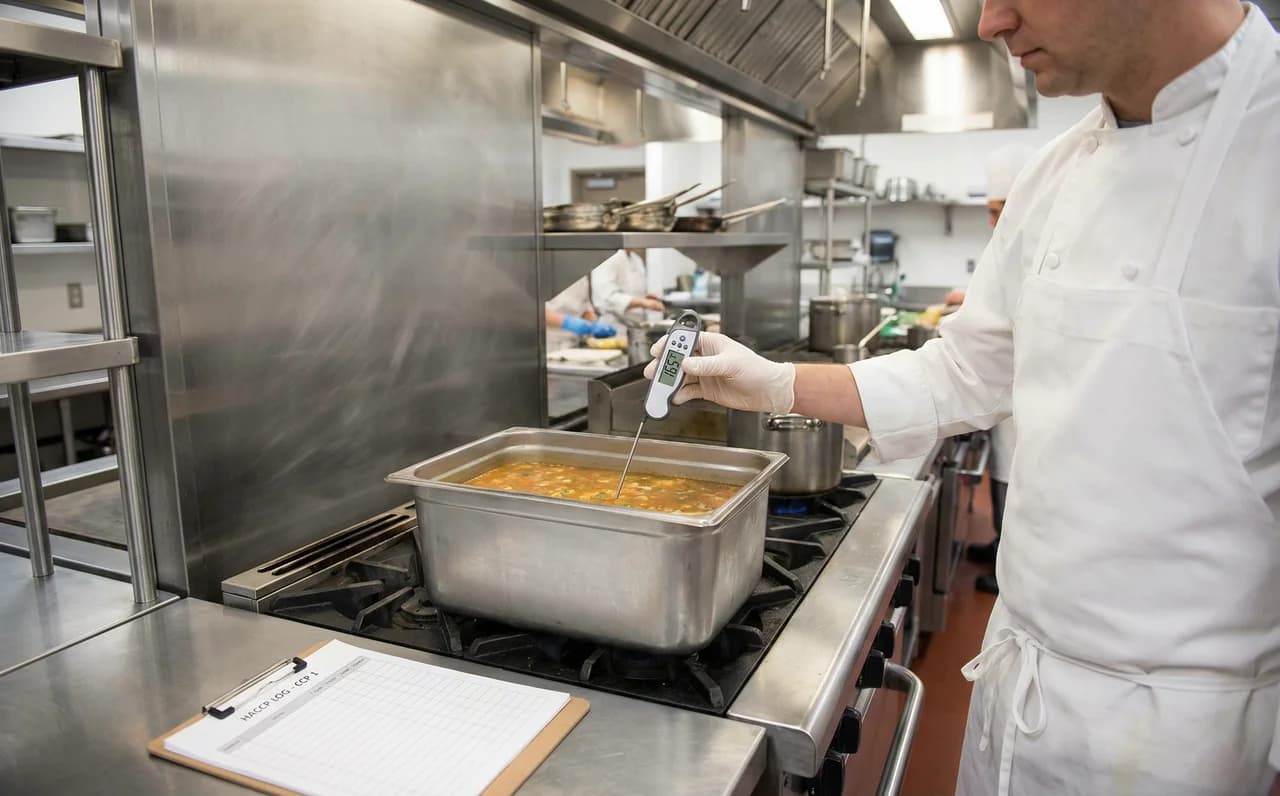
What CCPs are, how to set them in a typical kitchen, and how not to multiply control points 'just in case'.
The most common HACCP mistake: someone sets up 12 CCPs because "more is safer." The result? Nobody monitors them, the records are fiction, and the health inspector sees a paper shield. A CCP only makes sense when it meets three conditions:
- It addresses a genuinely significant hazard
- You have real control over it
- You can prove it (monitoring + records + response)
CCP vs GHP/GMP: the distinction that saves your entire system
- GHP/GMP (prerequisites): personal hygiene, cleaning and disinfection, zones, deliveries, storage, pest control - this is the "floor" you stand on.
- CCP: a point where one specific control is critically important, because if you fail here, the risk is serious.
If your GHP/GMP is not solid, then CCPs become an attempt to put out a fire with a teaspoon.
Decision tree: how to systematically identify CCPs
Codex Alimentarius (the international food safety standard) provides a tool to help identify CCPs: the decision tree. It sounds academic, but in practice it is a series of simple questions you ask at each stage of the process:
- Question 1: Do preventive measures exist for this hazard at this step? If NO - is control at this step necessary for safety? If YES - modify the step or introduce a measure. If NO - this is not a CCP.
- Question 2: Is this step specifically designed to eliminate or reduce the hazard to an acceptable level? If YES - this is a CCP.
- Question 3: Could contamination exceed the acceptable level at this step? If NO - this is not a CCP.
- Question 4: Will a subsequent step eliminate the hazard or reduce it to an acceptable level? If YES - this is not a CCP (because a later step will handle it). If NO - this is a CCP.
In practice, you do not need to draw a formal decision tree for every hazard. But the logic of these questions should guide every decision about designating a CCP. The point is that every CCP should be justified - not set "just because."
5 questions that help identify CCPs
At each stage of the process, answer:
- What is the worst that could happen?
- Can I prevent it earlier (through GHP/GMP)?
- Is this the moment where "I either control it now or it will be too late"?
- Can I actually monitor this under stress, during a shift?
- Do I know what to do if the parameter is out of range?
If the answer to 4) or 5) is "no," then this is not a CCP - it is wishful thinking.
What a CCP card looks like - what it must contain
Each designated CCP should have its own "card" - a document that clearly defines all the parameters. A good CCP card includes:
- CCP number and name - e.g., CCP1: Thermal processing of poultry.
- Process step - at which point in production this CCP occurs.
- Hazard - the specific hazard you are controlling (e.g., survival of pathogenic bacteria).
- Critical limit - the specific threshold value (e.g., internal temperature of at least 75 degrees Celsius for a minimum of 15 seconds).
- Monitoring method - how you measure (probe thermometer), who measures (shift cook), when they measure (with every batch).
- Corrective action - what you do when the limit is exceeded (extend cooking time, reject the batch).
- Record/log - where you record the result (CCP1 form, "temperature" column, date, signature).
- Verification - who checks and when to confirm the CCP is working correctly (e.g., manager reviews records once a week).
Where restaurants typically have sensible CCPs - and where they overdo it
This is not a "copy-paste" list. Your CCPs come from your process. But there are recurring patterns.
Most commonly sensible (depending on the establishment):
- thermal processing (where microbiological risk is real)
- cooling and storage (especially with larger production and warehousing)
- reheating / hot holding (if applicable)
- allergens (sometimes as a critical point at service or packaging, if allergen declarations are strong)
Most commonly overdone:
- making a CCP out of every handwashing
- making a CCP out of every delivery
- making a CCP out of "general cleanliness"
These are important things, but they should typically sit within GHP/GMP as standards and routines - not as a "critical point" to be measured several times a day.
How many CCPs is "right" for different types of establishments
There is no single magic number, but here are realistic benchmarks:
- Small cafe (cakes, sandwiches, beverages): 1-2 CCPs - most often storage temperature and possibly thermal processing (if you reheat).
- Full-menu restaurant: 2-4 CCPs - thermal processing, cooling/storage, possibly reheating and allergens at service.
- Delivery kitchen: 3-5 CCPs - same as a restaurant plus packaging and time/temperature during transport.
- Large-scale catering: 4-6 CCPs - more steps, more risks, but still a reasonable number.
Rule of thumb: if you have more than 6-7 CCPs in a small or medium establishment, some of them probably belong in GHP/GMP rather than as CCPs. Too many CCPs = nobody monitors them = fiction.
Monitoring: how often and by what methods
A CCP without monitoring is just words on paper. Monitoring must be:
- Realistic - it can be done during a shift, under stress, during peak hours. If monitoring requires 10 minutes of quiet work and your kitchen at peak is chaos - nobody will do it.
- Frequent enough - for thermal processing: with every batch. For cold storage temperature: at least once a day (twice is better). For allergens at service: with every order that has an allergen declaration.
- Documented - a measurement without a record does not exist for an inspector. A simple form: date, time, value, signature. Nothing more is needed.
- Performed by a specific person - "everyone monitors" = nobody monitors. Assign responsibility: the shift cook measures the temperature, the manager verifies the records.
Corrective actions: practical examples
"Corrective action" sounds formal, but in practice it is the answer to the question: "what do you do when something goes wrong?" Here are examples for typical CCPs:
- CCP: Thermal processing, temperature below standard - Action: extend cooking time, re-measure. If still below - reject the batch. Record: corrective action form with date, time, description of the situation, and the decision taken.
- CCP: Cold storage temperature above 5 degrees Celsius - Action: check the cause (door left open? equipment failure?). Assess how long the temperature was elevated. If briefly - cool down and monitor. If prolonged - assess product safety and consider disposal. Record: what happened, how long, what you did.
- CCP: Allergen mix-up at service - Action: stop the order, verify, correct. If the order already went out - contact the customer immediately. Record: order number, what went wrong, how it was fixed.
CCP verification: how you know the system works
Verification is not the same as monitoring. Monitoring is daily measurement. Verification is checking that the entire CCP system is working properly. It includes:
- Record review - once a week or month. Are the records complete? Were there deviations? How were they handled?
- Equipment calibration - a thermometer that reads 3 degrees too low is a disaster. Regularly check the accuracy of measuring instruments.
- Observing practice - are people actually doing what the procedures describe? Is monitoring real, or just "on paper"?
- Updating after changes - new menu, new equipment, new process? Check whether your CCPs are still appropriate.
Verification is your proof that the system is alive. Without it, you have documents but no system.
The biggest trap: "I measure, but I don't react"
A CCP without a response is theater. Every CCP should have:
- what you monitor (one specific parameter)
- when (point in the process)
- who (responsibility on the shift)
- what you do when there is a deviation (corrective action)
- where the record is (log)
And this is where the GastroReady system comes back: it is not about "having CCPs" - it is about making sure the team knows why they exist, how to use them, and what to do when something goes wrong.
Mini-check: are your CCPs "real"?
Answer YES/NO:
- Do you have just a few CCPs that your team can actually maintain?
- Is monitoring possible "on the go," not just in theory?
- Have you ever recorded a deviation and a response (not just ideal results)?
- Does everyone on shift know what to do when a CCP fails?
- Do your CCPs come from your actual process, not from a template?
- Do you have CCP cards with specific limits and monitoring methods?
If this is falling apart, the problem is usually not "lack of HACCP" - it is a poorly designed system.
Where GastroReady comes in
At GastroReady, CCPs are designed to be maintainable: simple, doable, and with proof of action. You get ready-made CCP cards with critical limits, monitoring methods, and corrective actions - tailored to your type of establishment. The logs are designed so that filling them out takes seconds, not minutes. The blog shows the logic. The system gives you the tools.
Need complete HACCP documentation?
GastroReady offers ready-made HACCP, GMP, and GHP templates for every type of food business. From 299 PLN, with PL/EN instructions.