Traceability and Batch Tracking: The Minimum Worth Having Even in a Small Kitchen
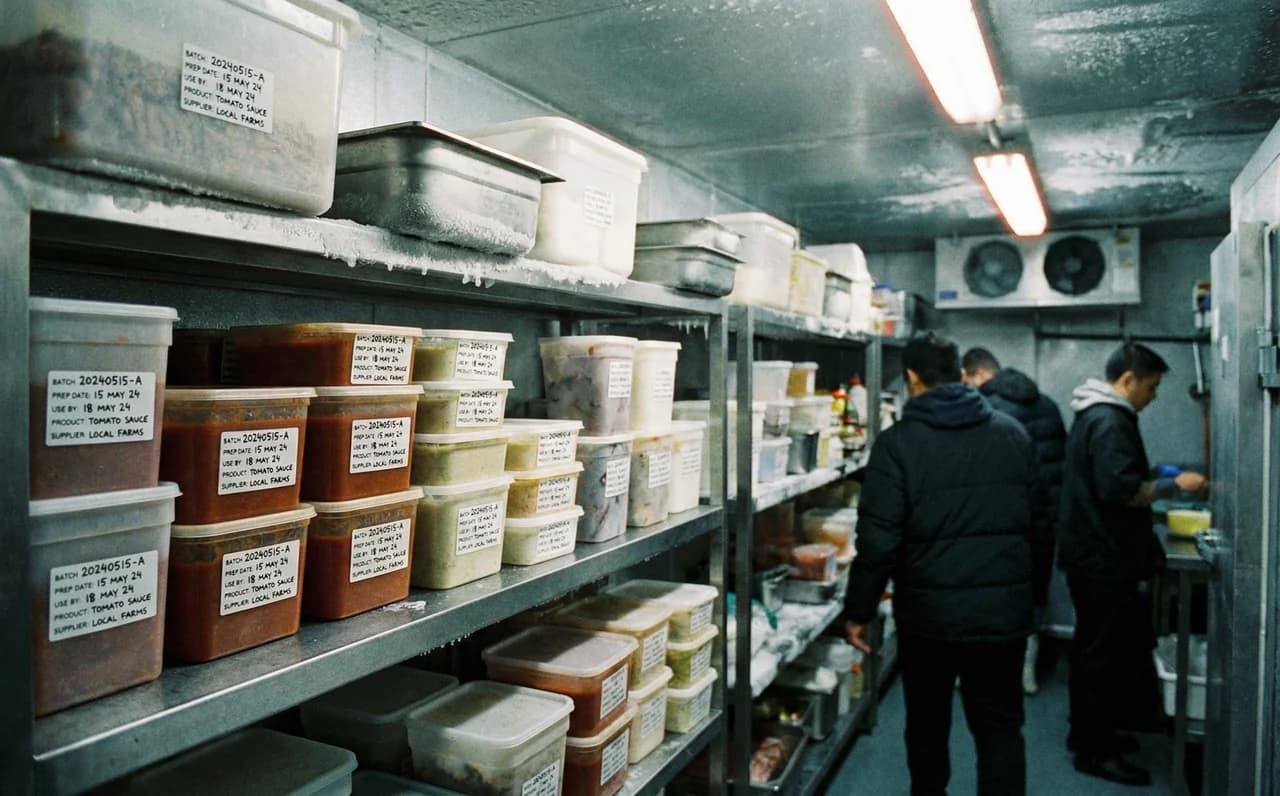
A simple batch labeling and ingredient-to-dish linking system, without overloading a small team.
Most small establishments operate in the mode: "we know what we have".
And then one of three things happens:
- a complaint that "something was off"
- a problem with a supplier
- an inspection question about origin / batch
And suddenly "we know" turns into "we think so". Traceability doesn't have to mean a massive system. It has to mean you're not guessing.
Legal basis: why this is not "optional"
Food traceability is a requirement of Regulation (EC) No 178/2002 of the European Parliament and Council. Article 18 is clear: food business operators must be able to identify who supplied them with a food product and to whom they supplied it. This is the so-called "one step back, one step forward" principle.
What does this mean for you as a foodservice operator? You must be able to answer two questions: "Who did you buy this product from?" and "What did you do with it?" Not tomorrow, not "when I find the invoice". Now. On the spot. During an inspection.
Penalties for a lack of traceability? Fines, administrative orders, and in cases of serious incidents (food poisoning, product recall) - legal liability. This is not a theoretical risk. It happens.
What the inspector actually asks about traceability
The inspector doesn't say: "Please show me your batch traceability system compliant with Regulation 178/2002". The inspector says something like:
"Where does this chicken come from?" - and points at meat in the cooler. You need to be able to say: "From supplier X, delivery from date Y, invoice/delivery note number Z". If you say "from our supplier" - that's not enough.
"When was this opened?" - points at a container with sauce. You need to be able to say: "Opened on Tuesday, use by Friday". If the container has no marking - you have a non-conformity.
"Could you show me the documents for the last dairy delivery?" - you need to be able to pull out the invoice or delivery note within 2 minutes. Not within the day. Not "when I find it". Now.
"If it turned out that a batch of cheese was defective - how would you check if you still have it?" - this is a test of your "forward traceability". You need to be able to say: "I check the delivery log, find the delivery from date X, check whether the product is still in storage or has already been used".
What traceability looks like in the "minimum" version
In practice, it's about two capabilities:
- Backward: what did I make this from? (delivery / supplier / batch)
- Forward: what was made from this? (where did I use this batch)
In foodservice, a simple version usually suffices: linking deliveries to menu usage + basic labeling in storage.
FIFO and FEFO: simple rules, big differences
Two acronyms everyone in the kitchen should know:
FIFO - First In, First Out. Meaning: what came in first, goes out first. Monday's delivery goes before Wednesday's delivery. This is the basic rotation rule that prevents expiration and food waste. In practice: old to the front, new to the back. On every shelf, in every cooler, in every storage area.
FEFO - First Expired, First Out. Meaning: what expires soonest, goes out first. This is an extension of FIFO. Why do you need both? Because sometimes Monday's delivery has a use-by date of Friday, but Wednesday's delivery has a use-by date of Thursday (because the product was closer to its expiration). In that case, FIFO says: "Monday first", but FEFO says: "Wednesday first, because it expires sooner". FEFO wins.
In practice: check the dates on the product, not just the delivery date. And teach this to your team - because "old to the front" doesn't always mean "shortest date to the front".
Labeling systems: stickers, dots, colors
You don't need a label printer that costs thousands. You need a system that is simple and that your team will actually use. Here are three approaches that work:
Date stickers. The simplest: a roll of stickers, a marker. On every opened product: date opened, use-by date (if applicable), who opened it. Cost: a few dollars for a roll. Time: 10 seconds per product. No excuses.
Color-coded day dots. Each day of the week has its own color. Monday = blue, Tuesday = yellow, Wednesday = green, etc. You open a product on Monday - you put a blue dot on it. On Friday, you see a blue dot and know: product opened 4 days ago. You don't need to read dates - just look at the color. This works phenomenally well in multilingual teams.
Full-information labels. For catering and larger operations: a printed label with product name, date opened, use-by date, batch number. This is a step up, but if you're producing in series - it's worth the investment.
The key: whatever you choose, apply it consistently. It's better to have a simple sticker system on 100% of products than an advanced label system on 30% of products.
A minimal system you can implement painlessly
- Keep delivery records in one place
Invoices/delivery notes/labels - everything in one "basket" (physical or digital). A "Deliveries" binder with monthly dividers. Or a folder on your phone with photos of documents. Not on loose papers scattered across drawers.
- Label opened products
You don't need to code the entire world. It's enough that an opened product has:
- date opened
- who opened it (or which shift)
- if needed: use by when
- Have a rotation rule (FIFO/FEFO)
The simplest rule: "shortest date to the front". And check this daily - 2 minutes in the morning when opening the kitchen.
- Know what to do when there's a problem
If a supplier calls: "batch X has a problem", then:
- you know where to check
- you can find whether you still have it
- you know whether it went into production
What to do during a product recall
The supplier calls and says: "Batch X of cheese has a problem. Please check if you have this product." What now?
Step 1: Find the product. Check the storage room, cooler, kitchen. Look for the batch number on the packaging and compare with the supplier's information. If you have a labeling system - this should take minutes, not hours.
Step 2: Isolate. If the product is on-site - immediately separate it from the rest. Label it "FOR RETURN / DO NOT USE" and move it to a separate location. Don't throw it away immediately - the supplier may want to collect it or you may need it as evidence.
Step 3: Check if you've used it. This is the hardest part. Did cheese from this batch already go into dishes? If so - which ones? When? If you have delivery records linked to production dates - you can answer this question. If you don't - you're guessing.
Step 4: Document. Record: what happened, when you found out, what you did, how much product you isolated, whether anything went out to customers. This record is your protection - it shows you responded responsibly.
Step 5: Contact the supplier. Confirm that you've checked, share your findings, agree on next steps (return, replacement, claim).
This entire process should take an hour at most. If it takes all day - your traceability system needs fixing.
Paper vs digital: what to choose
There's no single right answer. There are pros and cons:
Paper system:
- simple, doesn't require technology
- works without power or internet
- easy to implement immediately
- but: hard to search, easy to lose, takes up space, hard to analyze
Digital system (spreadsheet, app):
- quick search (find a delivery in 10 seconds)
- automatic backups
- easy report generation
- but: requires training, requires a device, risk of data loss without backup
Recommendation for small foodservice: start with paper, because you can implement it tomorrow. Once the team gets used to recording - you can switch to digital. Not the other way around. A system nobody uses is worse than no system - because it gives a false sense of security.
Most common pitfalls
- mixing products in one container without labels
- no opening dates
- no single location for delivery documents
- rotation "by eye" instead of FIFO/FEFO
- the belief "it's just a small kitchen" (that's exactly why it needs to be simple - because a small kitchen has no margin for error)
- no procedure for a product recall
Mini-test: can you do "traceability" in 10 minutes
Answer YES/NO:
- Can you identify which delivery the cheese you're currently using came from?
- Can you find the document for a specific supplier within 2 minutes?
- Do opened products have any labeling (date, color, sticker)?
- Do you know what to do if a batch has a problem?
- Do you follow the FIFO or FEFO rule?
- Can you answer an inspector's question "where does this product come from?" within a minute?
If you answered NO 3 times - you don't need "more discipline". You need a simple system that guides you step by step.
Where GastroReady comes in
GastroReady helps you build traceability "tailored for foodservice": simple FIFO/FEFO rotation rules, a product labeling system, delivery logs with filling instructions, a product recall procedure, and team implementation guides - also in PL/EN. You get a system that meets the requirements of Regulation 178/2002 without hiring a consultant and without buying software that costs thousands. The blog is here to show you that this is about risk and cost. The system is there to make it work every day.
Running a catering business? You need HACCP with delivery in mind
GastroReady HACCP documentation covers catering specifics: transport, cold chain, delivery critical points.