Receiving Goods in Foodservice: Temperatures, Dates, Documents, Quick Checklist
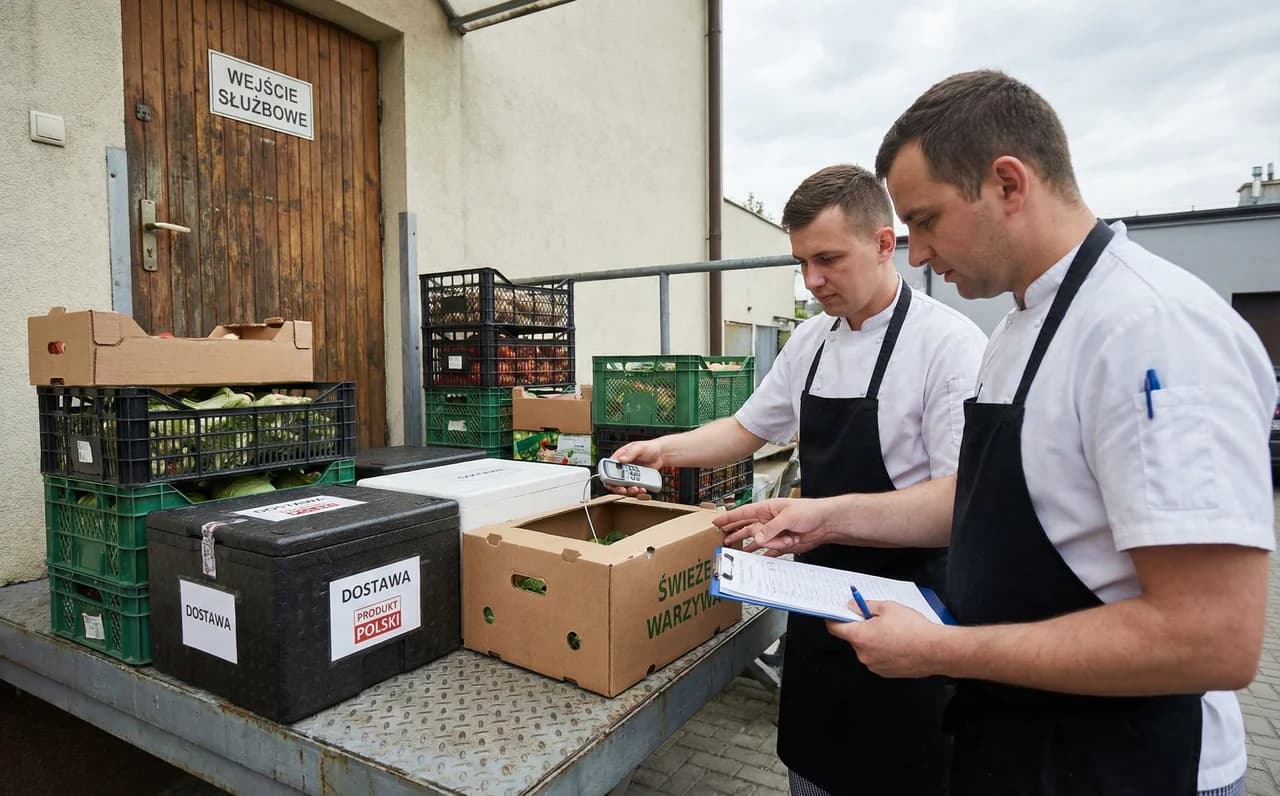
What to check when receiving a delivery and how to document it. A short checklist you can print or use on your phone.
Many owners focus on the kitchen but ignore what matters most: the receiving area. If you accept bad goods, you can have the best HACCP system in the world and still have a problem. This post gives you the "minimum that makes sense" - practical rules that work in real foodservice, not in a textbook.
Rule number 1: receiving happens "at the door", not "later"
The biggest trap: the supplier drops off the goods, you put them in the cooler, and then "sometime" you check. If you want control, receiving happens before the goods become "yours". Literally: you stand with the supplier, inspect, decide. Not an hour later, not "when I have a moment". Now.
Why does this matter so much? Because the moment goods enter your kitchen and go into the fridge - they become your responsibility. If the meat later turns out to have arrived at 12degC, you won't prove it was the supplier's fault. Because you have no measurement from the moment of receiving.
Who should receive deliveries
This is a question most establishments ignore. "Whoever happens to be around" is not an answer. Here are the rules:
- A designated person on each shift - the shift cook or manager. Not the dishwasher, not a trainee, not a server "who happened to walk by". Someone who knows the standards and has the authority to reject goods.
- A backup must be established - if the shift cook is on break, who receives? This must be clear BEFORE the delivery, not at the moment the driver buzzes the intercom.
- The receiving person must have access to a thermometer - the thermometer should be at the entrance/loading dock, not in a drawer in the office. Pull it out, measure, put it back. 15 seconds.
- The receiving person must know the temperature thresholds - not by heart, but they need a cheat sheet. A laminated card at the receiving station: meat max 4degC, frozen goods <= -18degC, dairy max 4degC. Look, compare, decide.
90-second receiving mini-checklist
- Packaging and condition
- Is anything damaged, wet, swollen, or dirty?
- Are meat/fish secured properly (no leaks)?
- Are boxes crushed, damp, or stained?
- Dates and identification
- Use-by / best-before date - is it legible and sufficient (min. 3 days remaining, unless you're using it immediately)?
- Is the product what you ordered (mix-ups happen more often than you think - you got beef instead of pork)?
- Are labels complete and legible (ingredients, allergens, producer)?
- Temperature
- Measure with a thermometer - not "by touch", not "it seems cold". A specific number.
- Fresh meat: max 4degC. Frozen goods: <= -18degC. Dairy: max 4degC. Fish: max 2degC.
- If the temperature is too high - see the "When to reject" section.
- Transport conditions - common sense check
- Did the goods arrive in a way that doesn't raise concerns?
- Do frozen items look like they were "thawed and refrozen" (ice crystals on the surface, changed shape)?
- Did the supplier's vehicle have refrigeration (if required)?
- Decision
- Accept / Reject / Accept conditionally (and what you do then - e.g. "use by end of day").
- Record
A brief record: date, supplier, temperature, decision. Without a record, you have opinions. With a record, you have evidence.
Delivery temperature standards - table
Laminate this and hang it at the receiving station:
- Fresh meat (beef, pork, lamb): max 4degC. Reject above 7degC.
- Poultry: max 4degC. Poultry carries the highest salmonella risk - zero tolerance.
- Fish and seafood: max 2degC (ideally on ice). Fish at 5degC is fish you don't want to serve.
- Frozen goods: <= -18degC. If the packaging is soft or deformed - signs of thawing.
- Dairy: max 4degC. Applies to milk, cream, yogurts, soft cheeses.
- Eggs: room temperature up to 18degC is acceptable during transport, but store in the fridge after receiving.
- Vegetables and fruits: no strict temperature requirement during transport, but they must not be rotting, moldy, or mechanically damaged.
- Ready meals (catering): hot >= 63degC, cold <= 4degC. A dish at 45degC is in the danger zone.
When rejecting goods is the best business decision
Sounds dramatic, but rejecting is often cheaper than:
- customer complaints,
- stress during an inspection,
- throwing out an entire batch later,
- reputational damage (one Google review saying "food poisoning at restaurant X" costs more than 100 rejected deliveries).
Documenting a rejection - what to record and how
You rejected goods? Good. But now document it, because otherwise in a week nobody remembers, and the supplier says "there was no problem".
- In the goods receiving log, record: date, time, supplier name, what was rejected, reason (e.g. "chicken temp 9degC at delivery", "damaged packaging - leaking"), who made the decision.
- Take a photo - you always have a phone in your pocket. A photo of the thermometer showing the temperature, a photo of the damaged packaging, a photo of the product with the visible problem. This is evidence that can be crucial when filing a complaint with the supplier.
- Notify the supplier in writing - text message, email, message in the ordering system. "Delivery from date X rejected: chicken temp 9degC. Please replace / issue credit." In writing, not verbally. Because verbal complaints "never happened".
- Keep the delivery document - delivery note, invoice, transport document. If you reject part of a delivery, mark on the document what was rejected and have the driver sign it.
Deliveries during rush hours - how to stay in control
Classic scenario: it's 12:30, lunch rush is in full swing, and the supplier calls: "I'm at the door". What do you do?
- Never accept goods "on faith" - even during rush hours. It's better to tell the supplier "wait 5 minutes" than to accept goods without checking. The supplier can wait. Your food safety can't.
- Quick version of the checklist - during rush hours, you don't need to do the full check. But you MUST do the minimum: temperature + visual inspection of packaging + dates. 60 seconds. You can fill in the rest after the rush.
- Goods go IMMEDIATELY into the fridge - not on the counter, not "by the door", not "next to the dishwasher". Into the fridge immediately. Every minute at room temperature is a minute in the danger zone.
- Agree on delivery times with suppliers - the best solution: morning deliveries (8:00-10:00), before the rush. If a supplier must come at noon - agree on a fixed time and prepare. Don't get caught off guard.
Supplier documentation - what to keep and for how long
A health inspector may ask: "Who do you buy your meat from? Do you have documentation?" Here's what you should have:
- Delivery documents (delivery notes, invoices) - keep for at least 1 year. In case of an inspection, you need to prove where a product came from. "I buy from the market" is not an answer the inspector wants to hear.
- Supplier certificates / attestations - veterinary identification number, supplier's HACCP certificate. You don't need to collect these with every delivery - once when you start working with the supplier, then update annually.
- Product specifications - especially regarding allergens. If you buy a sauce from a supplier, you need its ingredient list. "I think there are no nuts" is not food safety - that's guessing.
- Complaints log - every rejection, every complaint, every replacement. If a supplier has 3 rejections in a month - that's information that it's time to switch suppliers.
A "Suppliers" binder on your desk: certificates, specifications, copy of the complaints log. Update once a year. It's not a lot of work, but it makes a huge difference during an inspection.
Frozen goods inspection - what to watch out for
Frozen goods are a specific category because problems with them are harder to detect:
- Ice crystals on the product surface - indicate the product was thawed and refrozen. This is a red flag. Reject.
- Deformed packaging - frozen goods that arrived in a "soft" bag instead of a solid block may have thawed during transport.
- Color change - frozen meat that is grey or brown instead of red may have been stored too long or at the wrong temperature.
- Temperature at receiving - measure with a probe thermometer between packages. Minimum -18degC. If it's -14degC - ask what happened. If it's -10degC - reject.
- Rule: thawed = do NOT refreeze - if frozen goods thawed during transport, don't put them back in the freezer. Use them the same day or reject. Refreezing degrades quality and creates microbiological risk.
Most common delivery mistakes
- Receiving "on faith" - "the supplier is trusted, I don't need to check". You do. Trust is not a HACCP system.
- No standard for "who receives" - one day the cook, the next day a server, the day after the owner. Everyone does it differently. Nobody knows what to check.
- No rule for what to do when there's a non-conformity - "so what am I supposed to do with this?" That question should have an answer BEFORE the delivery, not during it.
- Records filled in retroactively - "because an inspection came, so I'll fill in the last month". The inspector can see this. Identical handwriting, identical temperatures, no deviations. Fiction.
- No temperature measurement - "it felt cold to the touch". By touch, -10degC and 3degC both feel "cold". But the difference is enormous.
Mini-test: does your goods receiving actually protect you? YES/NO
- Do you have a designated person for receiving deliveries on every shift?
- Do you measure the temperature of every meat and dairy delivery?
- Do you have a thermometer at the receiving station (not in the office)?
- Do you have a laminated cheat sheet with temperature thresholds at the entrance?
- Have you rejected any delivery in the last 3 months (if not - either you have perfect suppliers, or you're not checking)?
- Do you document rejections (photo + log entry)?
- Do you keep supplier documents (certificates, delivery notes) in one place?
- Do deliveries during rush hours also go through inspection - even the minimum?
If you answered "NO" 4 or more times - your goods receiving is a formality, not protection.
Where GastroReady comes in
GastroReady turns goods receiving into a repeatable process: a short receiving checklist, a log with space for temperature and decisions, a temperature threshold cheat sheet to hang at the entrance, a rejection procedure with a documentation template, and instructions for "what to do when something doesn't match". No improvising, no guessing - a system that works even when a new employee is doing the receiving.
Running a catering business? You need HACCP with delivery in mind
GastroReady HACCP documentation covers catering specifics: transport, cold chain, delivery critical points.