Adding Sushi or Sous-Vide? Updating Your HACCP in 2026
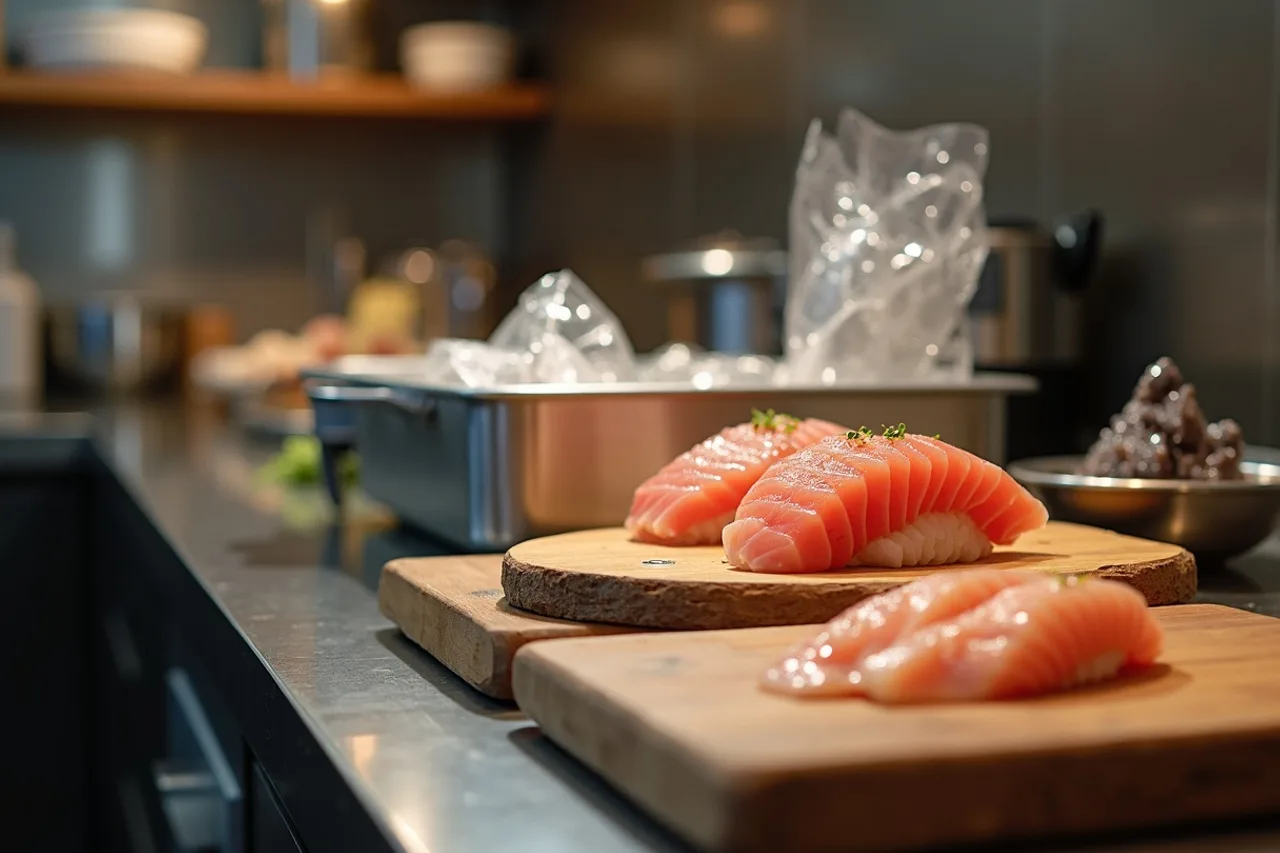
Sushi with raw fish and sous-vide introduce hazards your old HACCP doesn't cover. Learn how to update the hazard analysis and CCPs before you serve.
Your menu is growing - sushi, sous-vide, maybe a new line of desserts or dishes containing raw egg. The owner often thinks of this purely as a culinary and purchasing decision (new equipment, a new supplier, training the chef). Meanwhile, each of these processes introduces new health hazards that your current HACCP documentation - written for the old menu - simply doesn't cover.
This article shows why a new production process requires updating your HACCP documentation, what exactly the additional hazards are with sushi and sous-vide, and how to update the documentation without writing it from scratch.
Key takeaways
- Any new production process or product (sushi with raw fish, sous-vide, dishes with raw egg) requires updating the hazard analysis and critical control points in HACCP - not just adding a line to the menu.
- Sous-vide fundamentally changes the hazard profile - low-temperature, long-duration cooking requires precise control of time and temperature, unlike traditional heat treatment.
- Sushi with raw fish requires documented freezing at a specific temperature and duration to kill parasites - that's a concrete, legally grounded requirement, not a nice-to-have.
- Failing to update HACCP after a menu change is one of the most common reasons for non-compliance found during inspections at venues that have expanded their offering.
Why a new process means a new hazard analysis
A HACCP manual describes specific production processes and the specific hazards linked to them. When you introduce a new product or method of processing, at least one of the following changes:
- the type and source of biological hazard (e.g. parasites in raw fish, which weren't present with heat-treated meat)
- the critical parameters (time, temperature, pH) that need to be monitored and logged
- the stage of the process at which the hazard is eliminated or reduced to an acceptable level (CCP)
- the equipment required and its parameters (e.g. a sous-vide machine holding a constant, low temperature for a long time)
Documentation written for the old menu simply doesn't anticipate these elements - not because it's poorly written, but because it describes a different process.
Sushi and raw fish - what the additional risk involves
Serving raw or partially raw fish carries a risk of parasites (e.g. Anisakis), which can only be eliminated through appropriate freezing or heat treatment. EU regulations (Regulation EC 853/2004) require fish intended to be eaten raw or almost raw to be frozen under specific conditions:
- a temperature no higher than -20°C for at least 24 hours, or
- a temperature no higher than -35°C for at least 15 hours (depending on the equipment used)
In the HACCP documentation for a venue serving sushi, this stage must be explicitly described as a critical control point (CCP) - with parameters, a monitoring method (a log of freezing temperature and duration), and corrective actions in case of a deviation. It's also worth documenting the fish's origin from a supplier that either performs the parasite-killing freeze itself, or supplies the product already frozen appropriately - with confirmation on the commercial documents.
Sous-vide - time and temperature control as a new CCP
Sous-vide cooking involves heat treatment at a low, precisely controlled temperature (often 55-65°C) for an extended time, in a sealed vacuum bag. From a food safety standpoint, this is a completely different risk profile than traditional frying or high-temperature baking:
- a lower temperature means a narrower safety margin - too short a time or too low a temperature won't sufficiently eliminate pathogens
- the anaerobic environment (vacuum) favours certain bacteria, including Clostridium botulinum, if the process parameters aren't properly chosen and controlled
- the cooling stage after sous-vide cooking must be controlled just as precisely as the cooking itself - cooling too slowly gives time for bacteria that survived the low cooking temperature to multiply
In the HACCP documentation, this means designating sous-vide as a separate CCP with specific critical values (cooking temperature, cooking time, cooling time and temperature), a log of the parameters for each cycle, and a procedure for what to do in case of a deviation (e.g. what to do if the sous-vide machine failed to hold temperature for part of the cycle).
Checklist: what to do when introducing a new process or product
| Step | What it covers |
|---|---|
| 1 | Identify the new hazards specific to the process (biological, chemical, physical) |
| 2 | Check whether the new stage needs to be designated as a CCP and what its critical values are |
| 3 | Update the hazard analysis and process flow diagram in the HACCP manual |
| 4 | Introduce a new monitoring log (e.g. fish freezing temperature, sous-vide cycle parameters) |
| 5 | Train the team on the new procedure - including what to do in case of a deviation from the norm |
| 6 | Vet suppliers for the new product (certificates, confirmation of parasite-killing freezing, etc.) |
If you're not sure how to designate critical control points in practice, see our article CCPs in foodservice: how to identify critical control points. It's also worth checking our list of triggers that require a HACCP update, so you don't miss other situations besides a menu change.
What happens if you don't update the documentation
During an inspection, the inspector compares what they see in the kitchen (e.g. a sous-vide machine, fish being frozen for sushi) with what's described in the HACCP manual. A mismatch - a new process in the kitchen that isn't in the documentation - is treated as a serious non-compliance, because it means the system doesn't actually cover the processes genuinely in use, not just that one log entry is missing.
Where GastroReady fits in
Updating HACCP documentation after introducing a new process doesn't have to mean rewriting everything from scratch. GastroReady's packages are editable, so you can add a new process stage, a new CCP and a new log to the existing document structure, leaving the rest of the documentation unchanged. That's far quicker than commissioning a food technologist for an update every time the menu changes.
Frequently asked questions
Do I need to update HACCP for every menu change?
Not every change requires an update - a minor recipe tweak within an existing process usually doesn't alter the hazard analysis. An update is needed when you introduce a new production process, a new high-risk ingredient (e.g. raw fish, raw egg), or new equipment that changes the processing parameters.
What freezing temperatures are required for sushi-grade fish?
EU regulations require fish intended to be eaten raw to be frozen at a temperature no higher than -20°C for at least 24 hours, or -35°C for at least 15 hours, in order to eliminate parasites such as Anisakis.
Why does sous-vide need its own critical control point in HACCP?
Because the low cooking temperature and the anaerobic environment of the vacuum bag create a different risk profile than traditional heat treatment - they require precise control of cooking time and temperature, and fast, controlled cooling afterwards, to eliminate the risk of bacterial growth.
What are the consequences of not updating HACCP documentation after introducing a new process?
During a Sanepid inspection, a mismatch between the actual production process and the description in the HACCP manual is treated as a serious non-compliance, which can lead to post-inspection recommendations, a fine, or - in the case of a significant health hazard - further consequences.
Can I update HACCP documentation myself after adding a new dish?
Yes, if the documentation is in an editable format (e.g. DOCX), you can add a new process stage, a new critical control point and a new monitoring log yourself, using the existing document structure as a template.
Expanding your menu and need to update HACCP?
GastroReady gives you editable HACCP documentation that's easy to extend with a new process, a new CCP and a new log - without rewriting everything from scratch. From PLN 299, with PL/EN instructions.